

OneSource Virtual vs. ADP
OSV operates within workday, while ADP integrates. That difference determines whether your team spends time managing systems or driving payroll outcomes.
Trusted by 1,400+ Workday customers

Why should Workday customers choose a native approach?
You invested in Workday for unified data and streamlined workflows. Now you need payroll and compliance services to support that investment.
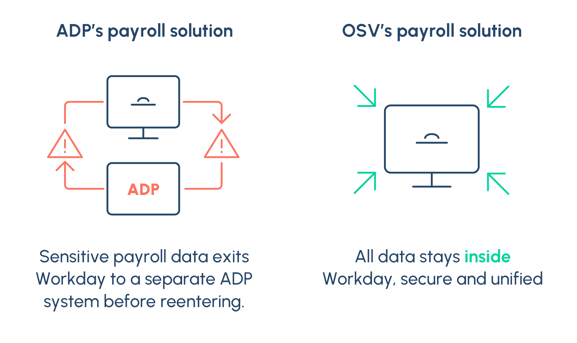
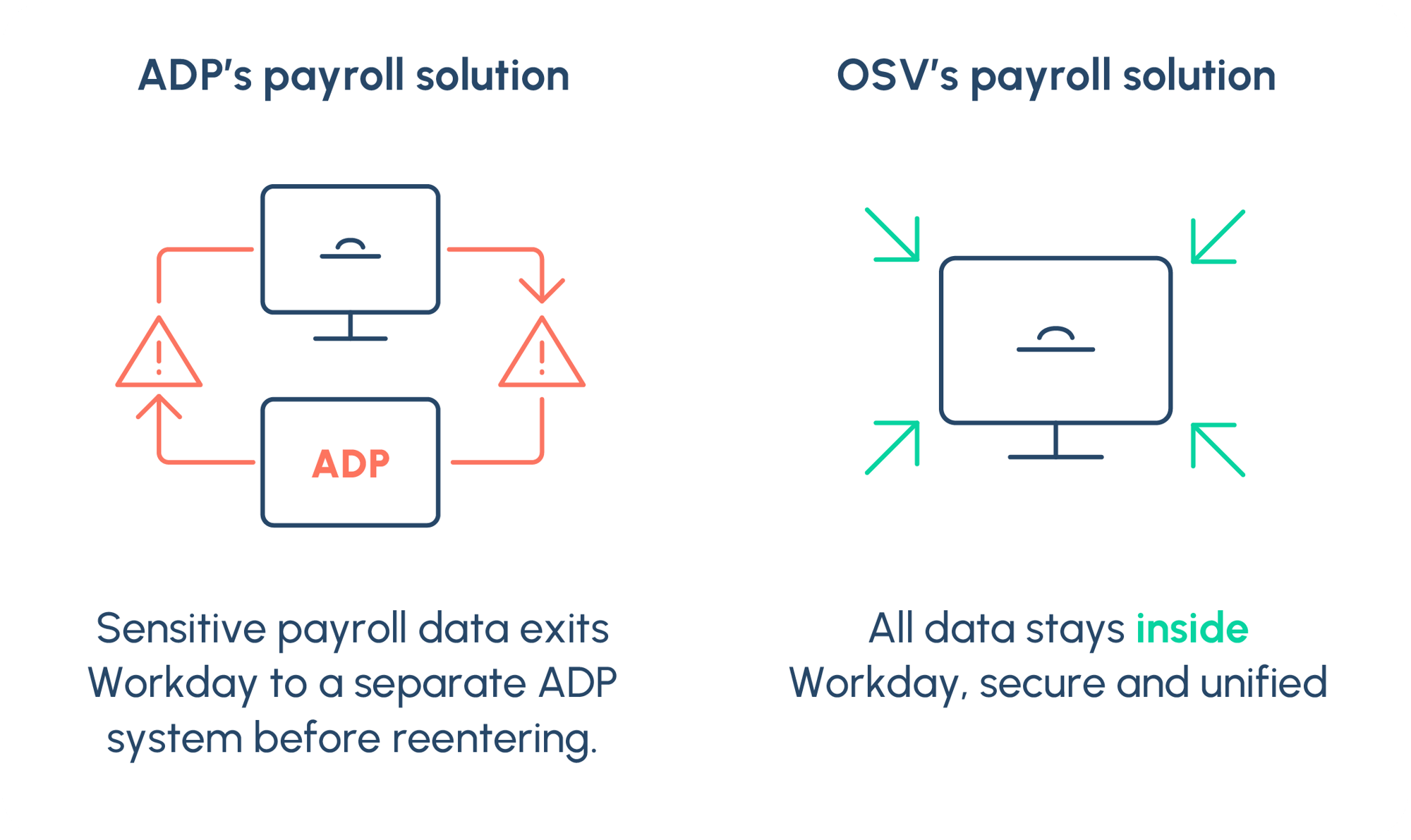
ADP connects to Workday through public APIs, but that's where their Workday relationship begins and ends. Your data travels out for processing in their separate system, then flows back in, creating integration points your team must maintain and reconcile.
OSV operates directly inside your Workday tenant using native functionality that external providers simply can’t access. Our Workday-certified experts configure, execute, and manage your payroll processes where your HCM data already lives, inside of Workday.
That’s not just a technical distinction; it’s the difference between a partner bolted onto Workday and one built within it.

With ADP's platform:
- Sensitive payroll data flows out of Workday, processes in ADP's system, then flows back into Workday
- Your team manages integrations, reconciles discrepancies, and monitors file transfers
- Employees toggle between Workday and ADP portals
- Your HCM team audits two separate systems
With OSV's in-tenant model:
- All payroll and HR operations happen inside your Workday instance — your data never leaves
- Zero integrations to manage, we operate within Workday's architecture
- Employees access everything through Workday
- Your security framework stays unified
| OSV's in-tenant model | ADP's external platform | |
|---|---|---|
| Payroll operations | Work entirely within Workday, using OSV's proprietary technology | Switch between Workday and ADP systems |
| Data movement | Fully managed in-tenant. API setup, maintenance, error flagging and reconciliation included | Customer-managed API integrations and fees; manual error reconciliation required |
| Security model | Utilize existing Workday security framework | Separate logins and security permissions |
| Support model | Named, dedicated team, and direct contact details | Multi-ticketing and triage system |
| Operating model | Works within Workday | New platform to learn and maintain |
What our customers achieve with OSV

Senior Payroll Manager, Del Monte Foods
Vice President, People Services and Insights, E.W. Scripps
Senior Payroll Analyst, Tory Burch
Payroll and System Specialist, TopGolf Callaway
Payroll Manager, NACCO Natural Resources
Why is OSV's in-tenant model better than ADP's external platform approach?
OSV runs payroll and compliance directly within your Workday tenant. As a OneSource Virtual customer, you can scale the level of support you need, thanks to our in-tenant approach. We configure, execute, and manage your payroll processes while providing a layer of human support to prevent errors.
How does OSV's service model compare to ADP's for Workday customers?
OSV provides dedicated, named support teams staffed with access to Workday-certified experts who understand Workday. OSV works within your tenant, our team can proactively identify and resolve issues before they impact your operations.
ADP's call center and ticketing model means you're often explaining your Workday setup to different support representatives who primarily know ADP's platform. Since their system operates externally and since they do not have in-tenant expertise, troubleshooting requires coordinating between your Workday environment and their platform, which adds time and complexity to issue resolution.
Is it secure for OSV to work inside our Workday tenant?
OSV’s in-tenant model enhances security by operating through Workday’s native role-based controls. You determine what OSV can access through existing security groups, and all activity is captured in standard Workday audit logs. ADP’s external platform transmits data out of Workday via APIs, creating multiple data stores with separate security protocols and access controls to manage. Many enterprise security teams prefer OSV’s model because sensitive data stays inside their controlled Workday environment rather than being replicated across external systems.
Do payroll teams need to access a separate system for payroll?
OSV is built using Workday's native functionality, which means all payroll operations happen within your Workday instance. Your team never needs to leave Workday to process payroll, review reports, or make payments. You see what we see.
Does OneSource Virtual 'native integration' mean we lose flexibility?
OneSource Virtual operates within Workday's framework; you retain full access to Workday's configuration and customization capabilities. Unlike external platforms that impose their own constraints and workflows, OSV adapts to how you've configured Workday, not the other way around.
How do our employees experience this change?
With OSV, employees access pay, tax forms, and statements through Workday, not through a separate portal. Organizations see fewer support tickets and better adoption because the experience is unified.
The real question isn't which provider has more features
It's which provider lets you stop managing systems and start driving outcomes.
OSV works where your Workday HCM data lives — inside the platform your team already trusts.